

Quick Summary
If you run regularly, whether it’s around your neighbourhood park connector, on a treadmill after work, or training for your next race, you’ve probably heard about running gait analysis. Some runners swear by it. Others aren’t sure if it’s just another add-on service.
As a sports physiotherapist in Singapore, I get asked this question almost every week:
“Is running gait analysis actually useful, or is it an overkill?”
This article is written to give you a clear, honest, and practical answer, based on what we see with real runners, not marketing promises.
The Problem: Why Runners Develop Pain

Running is one of the most accessible sports in Singapore.
But it’s also one of the most injury-prone.
Common complaints we see include:
- Knee pain after runs
- Shin splints that keep coming back
- Achilles or calf tightness
- Hip or lower back discomfort
- Foot pain that worsens with mileage
The challenge? Most runners don’t know why the pain keeps returning.
They stretch more, change shoes, rest for a while, then resume running, only for the issue to flare up again.
That’s because pain is rarely caused by just one factor.
How Running Mechanics Contribute to Injury

In clinical practice, I often explain this to runners:
Two people can run the same distance, in the same shoes, on the same route, yet only one gets injured. Why?
Because running load interacts with:
- Your movement patterns
- Your strength and control
- Your fatigue levels
- Your training history
Without understanding how your body moves while running, you’re often guessing.
This is where running gait analysis comes in.
What Is Running Gait Analysis (In Simple Terms)?

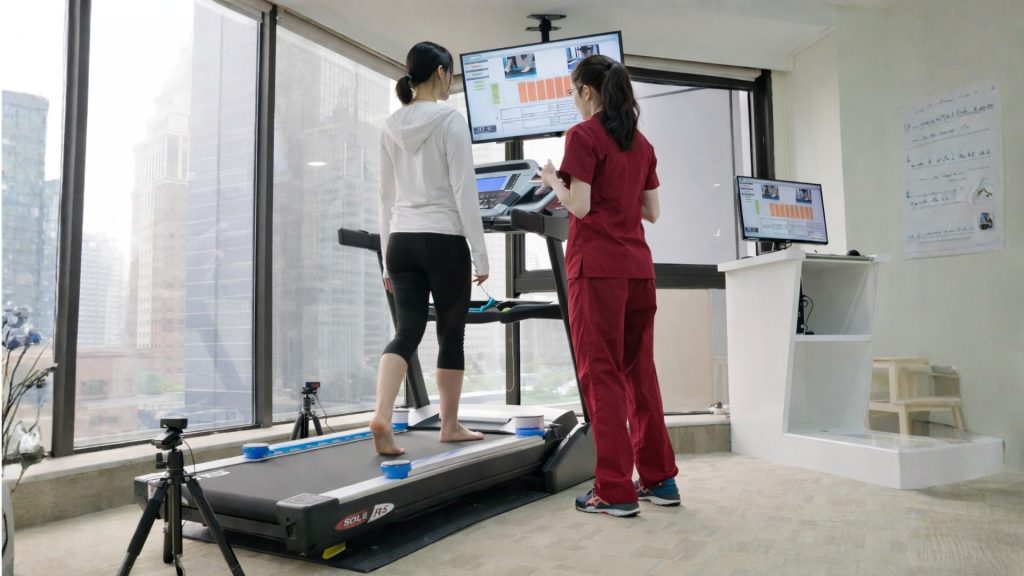
Running gait analysis is a structured assessment of how your body moves while running.
In a clinical setting, this usually involves:
- Running on a treadmill
- Video analysis (from the side and behind)
- A trained clinician analysing movement patterns
We look at how your joints, muscles, and posture behave under load, not just how things look when you’re standing still.
It’s not about labelling your running style as “good” or “bad”.
It’s about understanding what your body does repeatedly, especially under fatigue.
Is Running Gait Analysis Worth It?

For many runners, yes, but only when done properly.
A clinically useful gait analysis should help answer questions like:
- Why does pain appear after a certain distance?
- Which joints or tissues are being overloaded?
- Is this a strength issue, control issue, or load-management issue?
- What should actually change: training, rehab, or technique?
When it’s used this way, gait analysis becomes a decision-making tool, not just a visual report.
How Much Does a Running Gait Analysis Cost in Singapore?
This is one of the most common questions runners ask.
In Singapore, running gait analysis costs typically range from:
| Type of Assessment | Approximate Range |
|---|---|
| Basic treadmill video assessment | $80 – $150 |
| Clinical gait analysis with physio assessment | $150 – $250 |
| Advanced assessments (with rehab planning) | $200+ |
| The difference isn’t just price, it’s what you get out of it. | A higher-quality assessment usually includes: |
- Clinical reasoning (not just video playback)
- Strength and mobility assessment
- Clear explanation of findings
- Actionable recommendations
Is Gait Analysis Free?

Some runners ask if gait analysis can be done for free, and whether it’s even necessary.
Here’s the honest answer.
Free or basic screenings:
- Often focus on shoe selection
- May highlight obvious movement patterns
- Can be useful for general awareness
Clinical gait analysis:
- Looks at injury risk and load distribution
- Connects movement patterns to symptoms
- Guides rehab, training adjustments, and return-to-run planning
Do all runners need gait analysis?
No, but runners who experience:
- Recurrent injuries
- Pain that appears at predictable distances
- Plateauing performance despite training
- Uncertainty about what to fix
Often benefit the most!
Common Misconceptions About Running Gait Analysis

“It will fix my running instantly.”
Gait analysis doesn’t “fix” anything by itself. It guides what needs to be addressed.
“There’s a perfect running form”.
There isn’t. There are only forms that are appropriate for your body and goals.
“It’s only for elite runners.”
In reality, recreational runners often gain more value because small changes can prevent long-term issues.
What We Look for During Running Gait Analysis

As clinicians, we’re not just watching your feet.
We observe:
- Hip and knee alignment
- Pelvic control
- Cadence and stride patterns
- Foot strike behaviour
- Trunk posture
- Symmetry between sides
Most importantly, we look at how these change with fatigue. Many issues don’t show up in the first minute of running, but appear later.
When Should You Consider Seeing a Physio for Gait Analysis?

In the Singapore context, you should strongly consider a professional assessment if:
- Pain persists despite rest or self-management
- Symptoms worsen with increased training
- You’re returning from a running injury
- You’re training for a specific event and want to reduce risk
This is where a physiotherapy-led approach matters.
At Physio & Sole Clinic, gait analysis is used alongside:
- Strength assessment
- Mobility screening
- Load management planning
- Rehab or performance programmes
It’s never done in isolation.
How Gait Analysis Fits Into a Bigger Picture

Running injuries rarely come from one “faulty” movement.
They usually involve:
- Training errors
- Sudden load changes
- Weakness or fatigue
- Recovery gaps
Gait analysis helps us connect the dots. For example:
- A slight knee collapse may not matter at 5 km
- But at 15 km, under fatigue, it may overload the knee or shin
Understanding this helps us recommend:
- Targeted strengthening
- Technique cues (when appropriate)
- Training adjustments
- Gradual return-to-run plans
Is Running Gait Analysis Right for You?

Ask yourself:
- Do I keep guessing why pain happens?
- Am I unsure what to change in my training? Do I want clarity before committing more time or money?
If the answer is yes, gait analysis can be a useful investment, not just an assessment.
A Clinician’s Perspective

From experience, runners feel most reassured when:
- They understand why pain occurs
- They know what is safe to continue
- They have a plan, not just advice
That’s the role of good gait analysis, to support better decisions, not create fear.
Final Thoughts
Running gait analysis isn’t a magic solution. But when done properly, it provides clarity, direction, and confidence.
Ready to Get Clear About Your Running?
If you’re unsure whether gait analysis is right for you, a physiotherapy assessment can help determine the root cause of your symptoms and whether further analysis is needed.
Book an assessment at Physio & Sole Clinic and meet our physiotherapists to find out what genuinely supports your running and recovery.
Ready to feel better?
Book a consultation with our physiotherapy team to get an assessment tailored to you.