Podiatry condition
Gout痛风

Two things are worth saying plainly before anything else. A first attack belongs with a doctor, because gout is diagnosed and treated medically. And a hot, swollen, exquisitely painful big toe is not always gout, which is exactly where a podiatrist is useful: several other problems in that joint look much the same and are managed quite differently.
Gout at a Glance
| Detail | Information |
|---|---|
| What it is | Uric acid crystals forming inside a joint, causing sudden intense inflammation |
| Most common site | The big toe joint, in roughly half of first attacks |
| How fast it comes on | Hours. Usually worst within 12 to 24 hours |
| See a doctor | For a first attack, and for diagnosis and medication |
| See a podiatrist | When the toe keeps hurting between attacks, when it is not clear the pain is gout, and for footwear and joint care |
| Clinicians | Podiatrists |
When to See a Doctor, and When to See a Podiatrist
Gout is diagnosed and managed medically. That usually means a blood test for uric acid, sometimes drawing fluid from the joint to look for crystals, and medication both to settle an attack and, where attacks keep coming, to lower uric acid long term.
That part is medical, so if you have never been diagnosed with gout and your toe has suddenly become hot, swollen and severely painful, start with a doctor rather than a foot appointment.
A podiatrist is the right call at a different point: when gout is already diagnosed and the same joint keeps hurting between attacks, when it is not clear that what you are feeling is gout at all, or when footwear and the way you load that joint are part of the problem. Those are the questions the rest of this page is about.
The One That Must Not Be Missed
A joint infection, septic arthritis, can look almost exactly like a gout attack: one joint, hot, swollen, intensely painful. It is far less common and it is an emergency, because an infected joint can be damaged permanently within days.
Go to an emergency department rather than waiting if:
- You feel feverish or unwell with it, or have chills
- The redness is spreading up the foot
- There is a wound, a recent injection or recent surgery near the joint
- You have a weakened immune system, or diabetes
- You cannot move the joint at all, rather than it simply being too painful to move
Telling these apart is not something to do from a list, which is the point. It is also why a first attack belongs with a doctor.
What Else Looks Like Gout in the Big Toe
Once gout has been diagnosed and treated, something else becomes common: pain in the same joint that gets assumed to be another attack. Several things cause pain in the big toe joint, and they are managed differently.
- Hallux rigidus, osteoarthritis of the big toe joint. Stiff rather than hot, worse pushing off, and it builds over months rather than hours.
- Bunion, where the joint is becoming prominent and the shoe rubs it. The tenderness sits on the bump rather than inside the joint.
- Sesamoiditis, inflammation under the big toe joint, usually from running or dancing. Pain underneath rather than on top.
- Turf toe, a sprain of the joint after it has been bent back sharply.
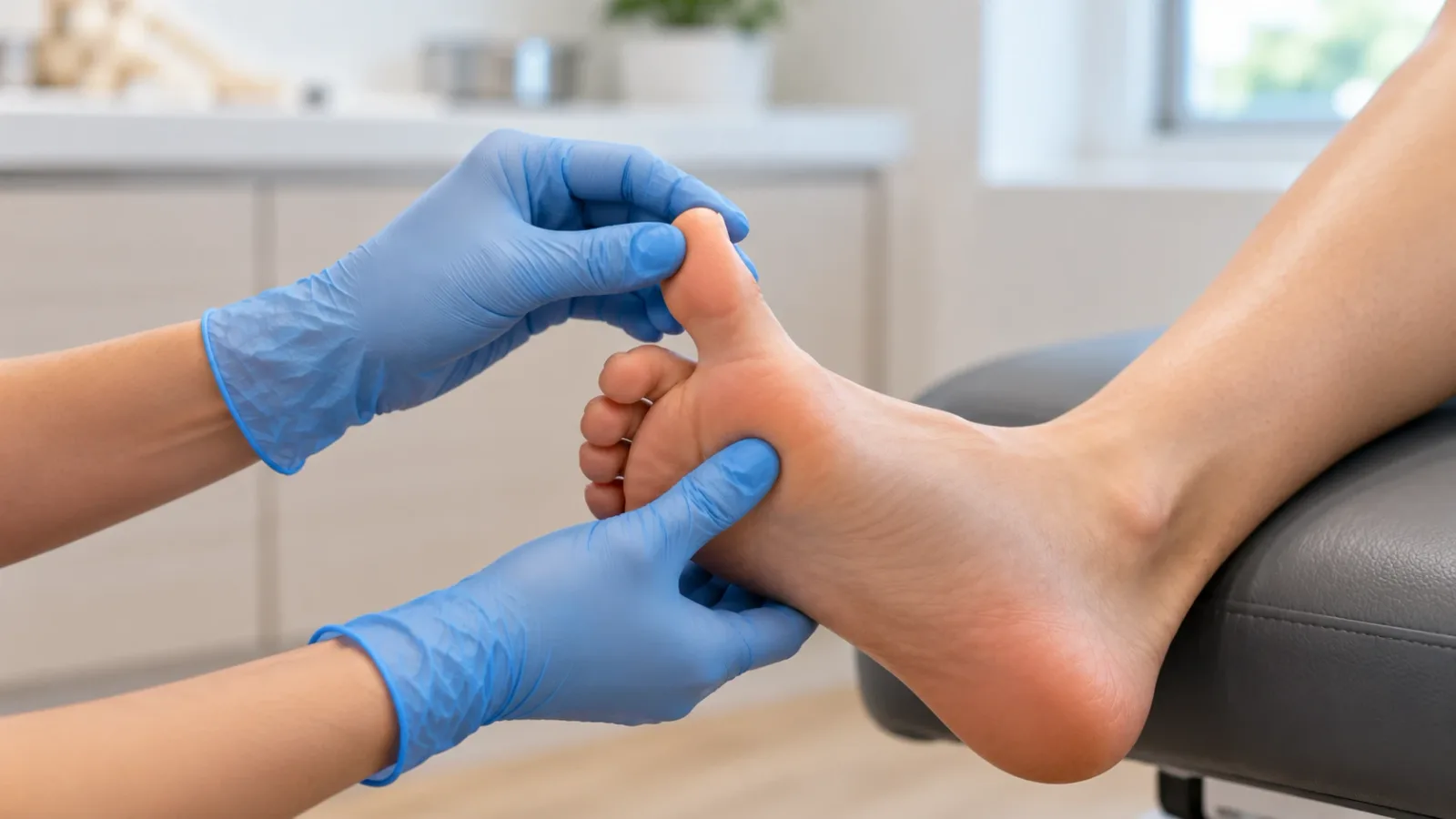
A useful question is how fast it arrived. A gout attack is a matter of hours. Most of the others are a matter of weeks.
What a Podiatrist Does Between Attacks
The medicine is the doctor's. What is left is the foot, and there is more of it than people expect, particularly for anyone whose attacks keep returning.
Protecting the joint during and just after an attack
- Footwear that takes pressure off the joint while it is still sore, which usually means something wide and soft rather than nothing at all
- Offloading or padding so you can keep walking without loading the joint
- Advice on what to avoid in the days afterwards, when the joint is settling but still vulnerable
Looking after the joint long term
- Repeated attacks can damage the joint, leaving stiffness and arthritis behind. That residual pain is a podiatry problem even when the gout is well controlled
- Customised insoles where the big toe joint needs load taken off it permanently
- Biomechanical gait analysis where the way you walk is adding to the load on a joint that is already damaged
- Footwear that accommodates a joint which no longer bends as far as it did
Where the skin is involved
- Long-standing gout can form tophi, firm deposits under the skin, which can break down and need care
- Anyone with gout and diabetes has two reasons to have their feet checked regularly, and diabetes foot care is where that starts

When Should You See a Podiatrist?
See a doctor first if this is a new, undiagnosed attack.
It is worth seeing a podiatrist if you have diagnosed gout and the joint still hurts between attacks, if shoes have become difficult because the joint is stiff or enlarged, if you are getting repeated attacks in the same foot joint, or if you have gout and diabetes together.
You do not need a doctor's referral to see a podiatrist in Singapore.
Frequently Asked Questions on Gout
Can a podiatrist treat gout?
Not the gout itself. Diagnosis and medication are a doctor's job, including the blood tests and the drugs that settle an attack or lower uric acid. A podiatrist helps with the foot: protecting the joint, footwear, offloading, and the stiffness or arthritis that repeated attacks can leave behind.
How do I know if it is gout or an infection?
You often cannot tell from symptoms alone, which is why a first attack needs a doctor. Fever, feeling unwell, spreading redness, a nearby wound, or being unable to move the joint at all point towards infection, and that needs an emergency department rather than an appointment.
Does what I eat cause it?
Diet contributes, but it is not the whole picture, and attacks often have no obvious trigger. Uric acid levels are affected by genetics, kidney function and some medications as well. Dietary advice is worth having from the doctor managing your gout rather than from a foot clinic.
Why does my toe still hurt when I am not having an attack?
Repeated attacks can damage the joint surface, and what is left behind is arthritis rather than gout. That pain behaves differently: stiff rather than hot, worse pushing off, and present most days rather than in episodes. It is also the part a podiatrist can help with.
Can I wear normal shoes during an attack?
Usually not comfortably, and forcing it tends to prolong things. Something wide, soft and easily adjusted is better than either a tight shoe or nothing at all, since walking barefoot on hard floors loads the joint too.
Do I need a referral to see a podiatrist for gout?
No. You can book a podiatry assessment directly at any of our clinics in Singapore.
Personalised care
Ready to get back on your feet?
Our podiatrists can assess your symptoms and build a care plan around your goals.
Cashless care options
Insurance
We work with leading insurers to make eligible physiotherapy and podiatry visits more convenient.









Direct billing is subject to your membership terms. Our clinic team can help check your panel eligibility.